Tourism Makes a Meaningful Step Toward Recovery: Hotels Top 80% Occupancy for First Time in 16 Months
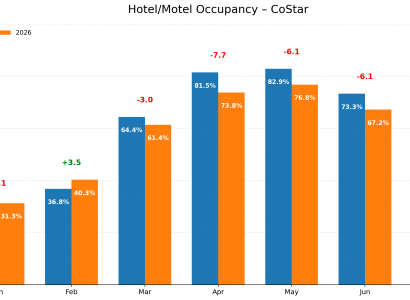
In brief: Page hotels ran 80.6% full in September, the first month above 80% since May 2025 and the first year over year gain since March. The gain came from rooms sold, with the nightly rate holding flat at $139. The City expects year over year comparisons to stay positive through the fourth quarter.
Page hotels ran 80.6% full in September, up 4.2 points from a year earlier. The last September above that mark was 2024.
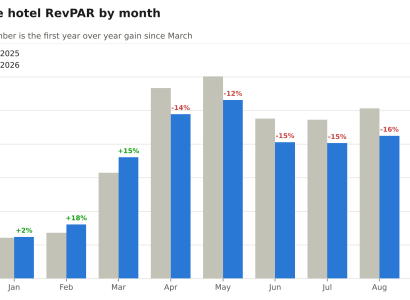
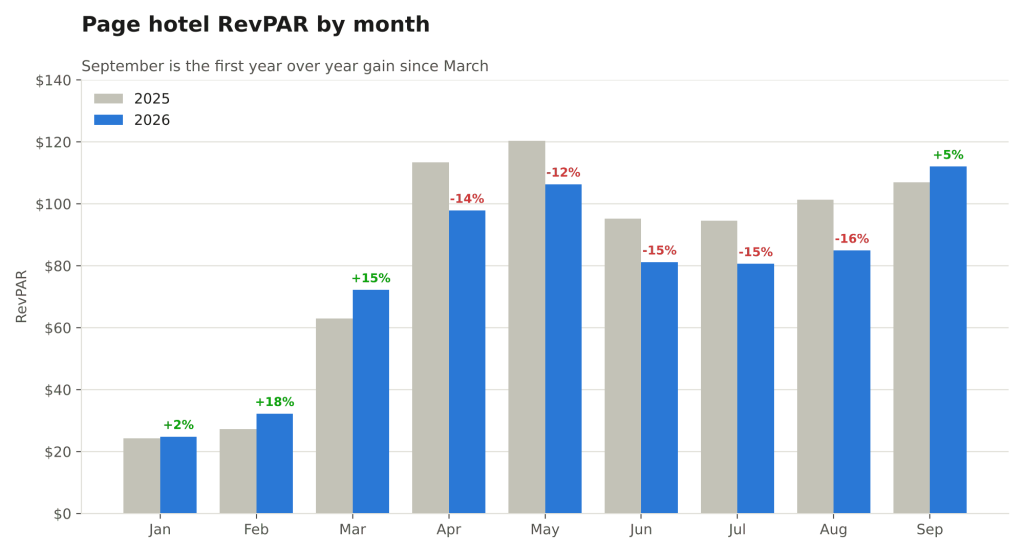
Hotels sold about 5% more rooms than a year earlier while holding the average nightly rate at $139. Revenue per available room rose to $112 from $107.
The month ends five consecutive monthly declines, each measured against the same month a year earlier. Occupancy had run 6 to 8 points below the prior year from April through August, with revenue per available room down 12% to 16%. Hotels and short-term rentals both sold more nights than a year earlier, with hotels posting the larger gain.
September hotel performance
Supply was unchanged year over year and CoStar’s demand measure rose alongside occupancy, so the gain is in rooms sold. That ends a slide that had deepened through the summer, with revenue per available room off 15% or more in June, July and August.
The longer view
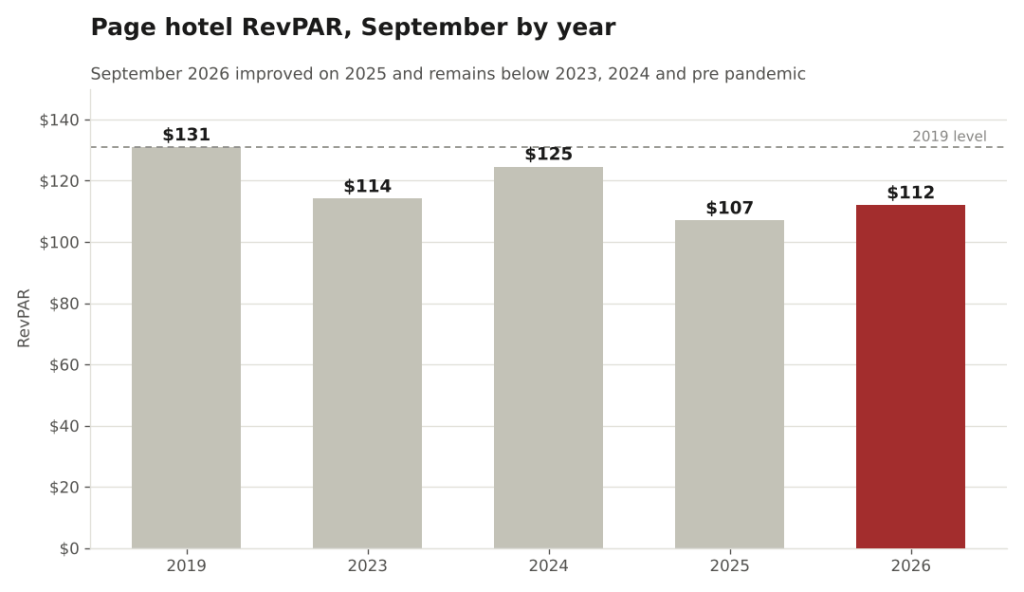
September 2026 still ranks fourth among the past five Septembers, roughly 10% below 2024 and 15% below pre-pandemic 2019. Taken as a block, June through September remains about 10% behind the same stretch last year. One strong month does not undo three weak ones.
Page held its average nightly rate at $139 while consumer prices rose 3.7%, so the rate gave up about 4% of its real value and the revenue gain works out to roughly 1% after inflation. Hotels nationally raised rates faster than that. Demand came back in September. Pricing power has not followed yet, and that is the part worth watching, because rate is where the next leg of recovery has to come from.
Short-term rentals
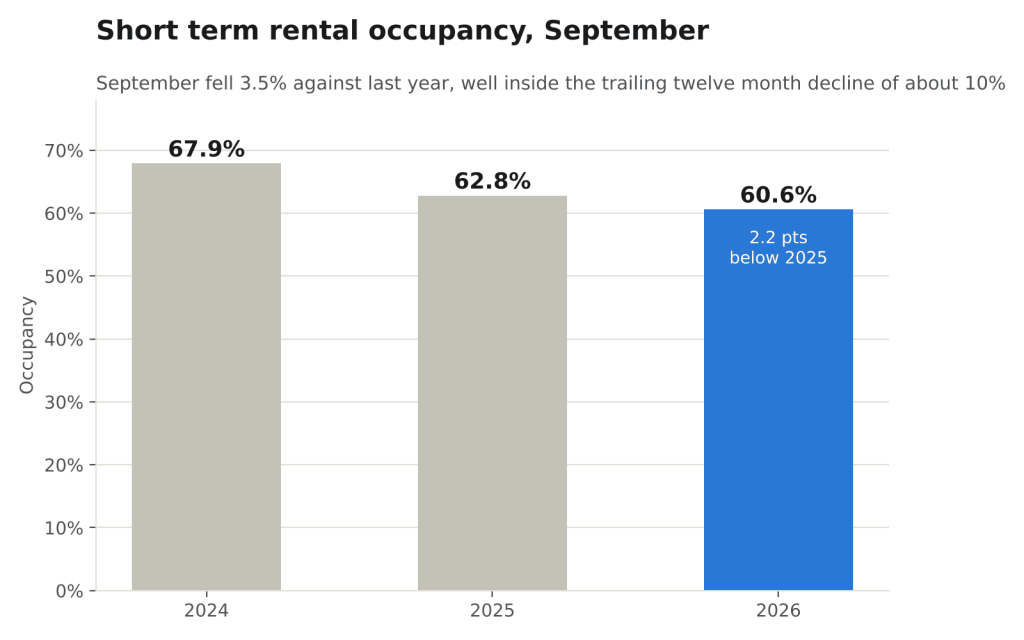
Short-term rental occupancy was 60.6% in September, down from 62.8% a year earlier, though booked nights rose about 2%. Active listings grew about 6% over the year, from 535 to 565, so more units are splitting a slightly larger pool of demand.
Revenue per listing came to about $34,900 across the trailing twelve months, down from roughly $41,900. That is about $7,000 less per unit before inflation, and added inventory accounts for roughly half of the occupancy decline over that period.
How Page compares
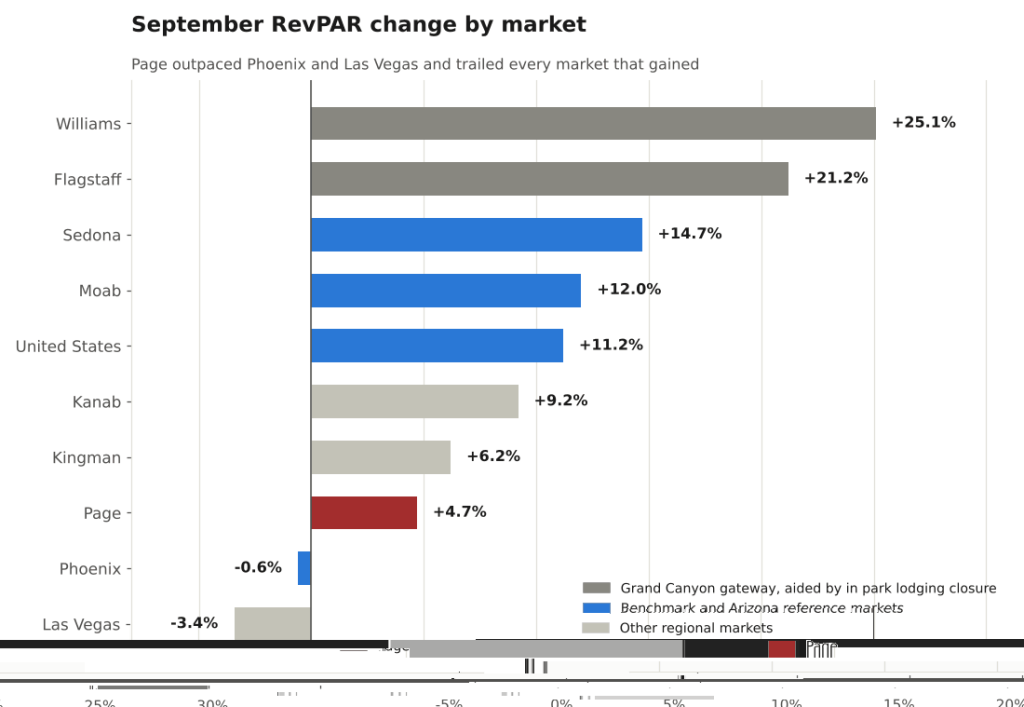
Almost everyone in the region gained ground in September, and Page’s 4.7% sits at the modest end of that group.
Williams and Flagstaff lead for reasons that have little to do with their own demand. Both absorb Grand Canyon South Rim overflow, and roughly a thousand in-park rooms sat closed all month. Flagstaff also carries a business travel base, which is what the national recovery ran on.
Moab and Sedona are the comparisons worth making. Both sell the same kind of leisure travel Page does, neither had a Grand Canyon windfall, and both outpaced Page. Sedona is the closest structural match in the state, a small scenic town with a large room count against a small population and no corporate base to lean on. It has one advantage Page cannot replicate: metropolitan Phoenix sits two hours away, which puts a weekend market of several million people within reach when long-haul travel softens. Kanab got to its gain a different way, lifting its rate about 7% while occupancy barely moved.
Phoenix held flat, with the rate unchanged and occupancy off a fraction of a point. Phoenix holds most of Arizona’s hotel rooms, so Page gained in a month when the state’s largest lodging market did not.
What was happening in September
Severe flash flooding on Bright Angel Creek destroyed the Transcanyon Waterline on August 29, closing all South Rim in-park lodging from August 31 through September, with repairs expected around Thanksgiving. Visitors were told to bring their own water, restaurants ran limited service, and several inner canyon trails and both river bridges closed. The displaced guests went to Tusayan, Williams and Flagstaff.
U.S. revenue per available room rose 11.2% in September. Sunday through Thursday performance was up 16.7%, weekday demand supplied 93% of the additional room nights, and group bookings at upper-tier hotels rose more than 25%. That is a business travel recovery, and Page sells to leisure travelers.
Overseas arrivals to the United States totaled 2.7 million in September, down 4.3%, with the year to date down 5.7%. Western Europe accounted for nearly three quarters of the drop: France down 15%, the Netherlands down 13%, Ireland down 12%, and Germany and Italy down 10% each. Asia came in close to flat, with China up nearly 15% and Taiwan up nearly 13% against South Korea down 25%.
The international outlook
Travel industry forecasters, presenting at a session hosted by the Arizona Office of Tourism this month, pushed their international recovery timelines out by several years compared to their read on markets from 6 months ago, with Canada and the United Kingdom anticipated to be the slowest. Mexico has already begun recovering and should return ahead of Europe.
That outlook carries particular weight in Page. Domestic trips fell in September while room nights rose, which puts the month’s gain on international travelers.
Visitor volume and spending
Domestic trips to Page totaled about 154,000 in September, down from roughly 174,000 a year earlier. Average length of stay rose from 2.4 days to 2.6. Spending in town came to about $18.4 million, down 4.8% from $19.3 million in September 2025. Visitors and regional shoppers accounted for 75.6% of that spending and Page households the rest. Friday is the heaviest spending day of the week, Wednesday the lightest.
Placer has visitor spending down 5.4% across the trailing twelve months against the twelve before it. September’s decline came in at about the same rate, so the month that broke the losing streak in room nights did not break it in spending.
Domestic visitation fell in September by two independent measures, down 6.9% by Placer and 11.4% by Datafy, in a month when room nights rose about 5%. Neither vendor tracks international travelers, so the gap between falling domestic visitation and rising occupancy points to international demand as the source of the month’s gain.
The outlook
The City is optimistic about what September showed. The gain came from rooms sold and not from pricing, supply was unchanged, and hotels and short-term rentals both participated. Demand itself moved, which is what the start of a recovery looks like.
We expect the year over year comparisons to stay positive through the fourth quarter. October and November were two of the weakest months of 2025, down 9.1% and 15.2%, so the bar in front of Page is low. September’s gain also came from rooms sold with the rate held flat, which is a more durable kind of gain than one bought with discounting.
Fourth quarter volume is small in absolute terms, with occupancy in the 40s by November and the 30s in January, so March and April are the first months carrying enough traffic to confirm a trend. What shows up then depends largely on fuel prices and household budgets. Nearly everyone who comes to Page arrives by car and most have driven a long way to get here, which makes fuel a heavier factor in this market than in a destination sitting next to a population center.
What the City is doing
City tourism marketing is running on several tracks this fall.
On the booking side, the City is buying targeted placements with Booking.com, Agoda and TripAdvisor, alongside Sojern campaigns aimed at travelers already planning a Southwest trip. Paid social and a mix of print and digital advertising run with them.
In the drive markets, the City has committed to Road Trippin’ news segments out of Salt Lake City, is expanding broadcast advertising into Boise, and is preparing radio advertising on KROQ in Los Angeles.
For visitors already here, the focus is length of stay. The City is expanding its digital passports and itinerary tools and distributing new visitor guides and passport rack cards to hotels. An influencer visit is planned around the Balloon Regatta, and the City is working with Navajo Nation tour operators to raise the profile of lesser known attractions.
On the international side, the City is hosting FAM tours and has engaged a vendor to expand its international visitor data, which would replace estimates with measurement in future reports.
What this means for your business
Occupancy came back without rate cuts, which says the market bore current pricing even in a soft year. That is an argument for holding rate through the fourth quarter.
Midweek remains the soft spot in both lodging and retail. Friday is the heaviest spending day in town and Wednesday the lightest, a pattern that has held all year.
Fourth quarter comparisons will look strong against a weak 2025. Judge the season on rooms and covers rather than on the percentage change.
Grand Canyon in-park lodging reopens around Thanksgiving. Some of the displaced demand that has moved through the gateway towns since late August will go back inside the park with it.
The bottom line
Page’s lodging market stopped falling in September. Occupancy came back, rates held, and both hotels and short-term rentals sold more nights than a year earlier. It was the first clearly positive signal since spring.
The gain came against a weak comparison and Page still sits below its 2023 and 2024 Septembers, so one month is not a trend.
The shape of the month says something about where the recovery is coming from. Lodging rose while domestic visitation fell. Hotels, where international guests concentrate, outperformed short-term rentals. Rates held firm, which happens when returning demand is less price sensitive. Through 2026 Page’s results have tracked international arrivals more closely than the domestic hotel cycle, and international exposure explains the pattern better than anything else available.
One month does not undo the year. It does change the direction, and it is the first time since spring that the question in front of Page is how much of this holds instead of how much further it falls.
The City is here to help local businesses compete and grow. Reach out any time by visiting our Contact Us page.
###
*Note: Hotel data is from CoStar and reflects participating properties as of the October data pull; CoStar revises prior months as additional properties report. Short-term rental data is from AirDNA and reflects market estimates. Visitor volume and spending data is from Datafy and Placer.ai, both of which cover domestic visitors only and reflect activity in Page, excluding lodging and tours prepaid elsewhere. National lodging figures are from CoStar, and international arrival figures are from the National Travel and Tourism Office, both preliminary. International recovery expectations reflect travel industry forecasts presented at an Arizona Office of Tourism session in October 2026. Inflation adjustments use the U.S. Bureau of Labor Statistics consumer price index, which rose 3.7% in the twelve months to September 2026. Figures are rounded.*