Page's Tourism Numbers Ease Off the Peak, but the Consumer Holds strong
City of Page Economic Update, July 2026
Page’s spring numbers are now closed, and with the summer season underway, they are worth reading carefully. They show a tourism economy settling back toward normal after the strongest year in the City’s history, with the softness concentrated almost entirely in lodging. They also show Page slipping further than the markets around it, for reasons that are identifiable and, in at least one case, addressable.
The May report
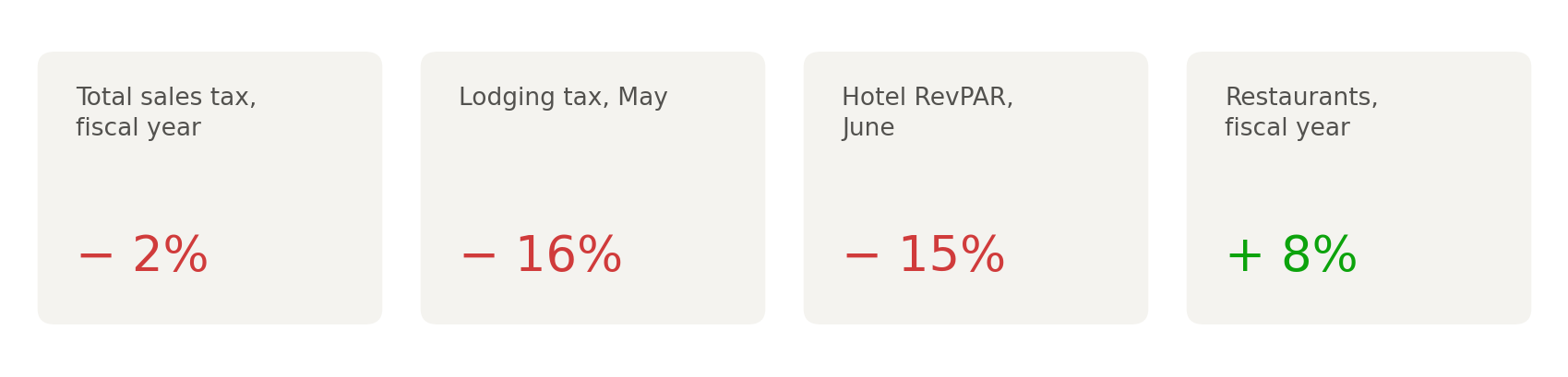
City sales tax collections in May totaled about $1.92 million, down roughly 9% from a year earlier. The fiscal year to date is down about 2%, and the trailing twelve months less than 1%.
The single month looks worse than the trend for a straightforward reason. Page is being measured against May 2025, which fell inside a record year built on an exceptional post-pandemic travel surge. Lapping a record is difficult, and the current figures are best read as a return toward normal rather than a decline in the underlying business.
Lodging accounts for nearly all of the softness. Hotel, motel, and vacation-rental collections fell about 16% for the month, and because rooms made up roughly 45% of May’s total, that single category drives most of the decline. The rest of the economy held. Restaurants, bars, and catering are up nearly 8% for the fiscal year. Remote-seller collections are up about 13%, use tax about 11%, and retail is roughly flat.
Reading the numbers in real terms
Two adjustments matter for anyone comparing years, and they work against each other.
In September 2024 the City’s combined lodging tax rate rose from about 7% to 10%, which inflates raw dollar comparisons. Inflation cuts the other way, since a dollar buys less than it did two years ago. Setting the rate change aside, real lodging revenue in May came in about even with 2024 and ahead of 2023. Accounting for inflation as well, it sits slightly below 2024 and still above the pre-surge 2023 level.
Inflation has been running unusually warm, which affects that calculation. Headline consumer prices rose about 4% in May, the fastest pace in three years, driven almost entirely by an energy spike tied to conflict in the Middle East. A portion of the decline measured in real terms reflects that temporary price surge, which is already unwinding.
Hotels and short-term rentals
Page rents rooms two ways, and each softened for a different reason.
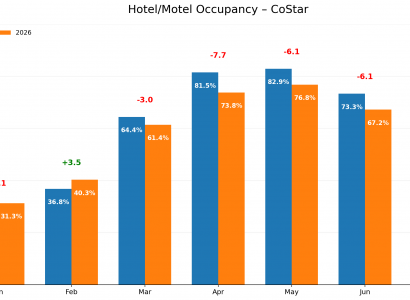
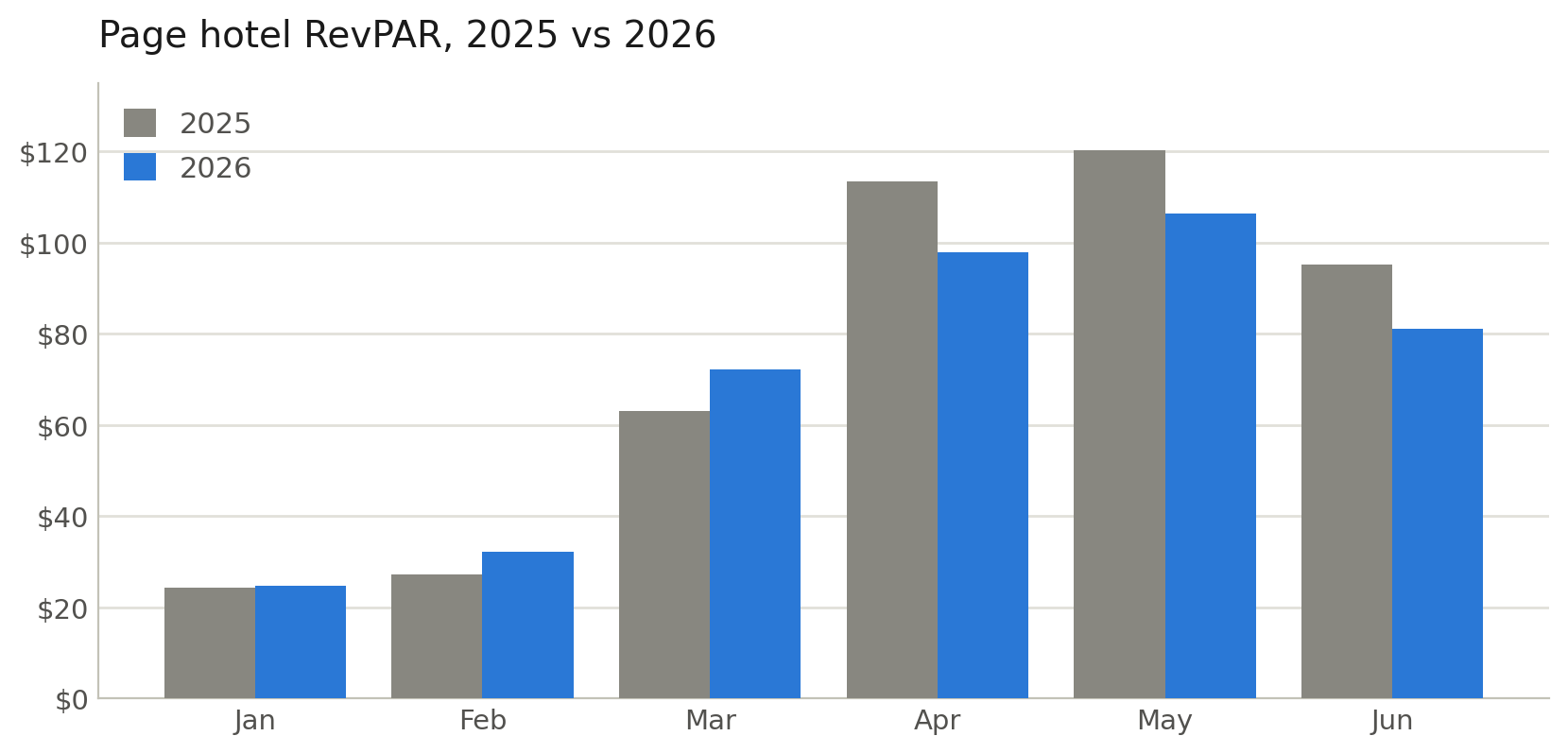
Hotels opened the year strong, with both occupancy and rates running ahead of 2025 through the winter and early spring. The second quarter cooled. Rooms sold fell 7 to 9% in April, May, and June, and because the number of hotel rooms in Page has not changed, that represents a genuine decline in demand rather than the same visitors spread across more inventory. Rates eased another 5 to 7%. June was the softest month, with occupancy near 67% and an average daily rate of about $121. For the first half of the year, hotel room revenue is down about 6.5%.
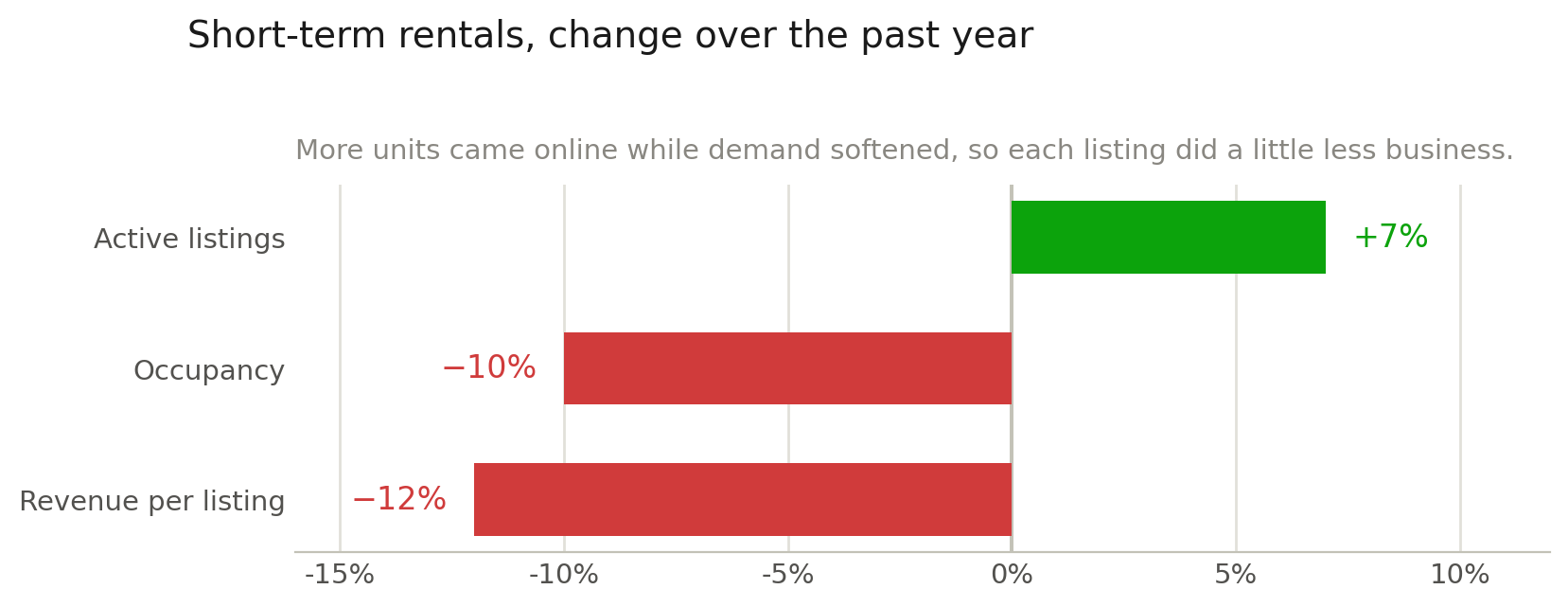
Short-term rentals followed a different path. Supply grew about 7% over the year, to roughly 570 active listings, leaving more units to divide a softer pool of demand. Per-listing results absorbed most of that, with occupancy down about 10% and revenue per listing down about 12%, while the segment as a whole came in 6 to 7% lighter, close to hotels. Booked nights in June ran about 13% below last year, though still ahead of 2023.
Those two segments explain why the same softening appears as different numbers depending on the measure. Occupancy is the mildest reading, because it records only whether a room sold, not for how much. Revenue falls faster, since it combines rooms and rate. The lodging tax line fell hardest, about 16%, because it captures short-term rentals alongside hotels and rentals softened more. Total city sales tax barely moved, because rooms are only about 40% of the base and the remaining categories grew.
Regional comparisons
The more useful comparison is against neighboring markets. Here is how June room revenue per available room changed year over year across the region:
- Las Vegas: up about 6%
- Flagstaff: up about 3%
- Moab: up about 2%
- Lake Havasu City: down about 1%
- Kanab: down about 4%
- Kingman: down about 8%
- Williams: down about 9%
- Page: down about 15%
Page is the only market in the group down double digits. That comparison matters, because towns with similar profiles held up considerably better. Moab, the gateway to Arches and Canyonlands, rose. Kanab, which serves Zion, slipped only slightly. If the national-park road-trip circuit itself were weakening, those markets would show it, and they do not. Two forces appear to be at work, one shared across the region and one that falls more heavily on Page.
Fuel costs and the Lake Powell narrative
The shared factor is fuel. A spring price spike, driven by the same Middle East conflict that lifted inflation, pushed the national average toward $4.56 a gallon by late May, in the middle of the travel planning season. For a region that depends on road trips, higher fuel prices raise the cost of every visit, which helps explain why even the region’s stronger performers managed only modest gains. Prices have since fallen back below $4.00 as summer begins.
The factor specific to Page is harder to quantify. Page is the community most closely associated with Lake Powell, and Lake Powell has spent the year as a fixture of national coverage focused on record-low water levels. The most instructive comparison is Lake Havasu City, which draws on the same river system, experiences the same summer heat, and pays the same fuel prices, but has a full reservoir and receives little of that coverage. Havasu finished essentially flat. Page fell 15%.
The water level itself does not appear to be the constraint. The lake is open, and the large majority of visitor experiences are unaffected by the elevation reading. What has softened is perception, and perception is something a destination can work on.
The broader picture
Page’s cooldown has considerable company. In 2025 the U.S. hotel industry recorded its first revenue decline outside a recession, and national occupancy now runs near 62%, close to where Page sits. Page is moving with the national trend rather than lagging it.
International travel is a larger factor for Page than for its more domestic neighbors. Canadian visits to the United States remain down by double digits, European demand has cooled, and a new federal surcharge adds $100 per person for international visitors at Grand Canyon, Zion, and Bryce Canyon, the parks that bracket a typical Page itinerary. As a Grand Circle hub, Page feels that pressure more than an interstate community does. Two points are worth noting alongside it. Page’s own signature attractions fall outside that surcharge. And the Arizona Office of Tourism expects international visitation to recover by 2028, which places the current softness within a defined window rather than an open-ended decline.
There is also evidence of travelers trading down. As household budgets tighten, more affordable destinations gain share, and Laughlin has grown as Las Vegas prices some visitors out. With average room rates above $120, Page sits at the higher end of the regional market, which suggests some of the missing demand shifted to less expensive options rather than disappearing.
A resolution on the river is approaching
The water story is also entering a new phase, which has implications for how it is covered.
The rules governing Lake Powell and Lake Mead, set in 2007 and supplemented in 2019, expire at the end of this year. The seven basin states have not reached consensus on what replaces them, so the Department of the Interior is finalizing federal guidelines. A draft plan is due July 31, with final rules expected before the new water year begins October 1.
That will not raise the reservoir, and the plan is expected to include reductions for multiple states. Litigation remains possible, with several states preparing for a potential legal challenge. But it does bring more than two years of open-ended negotiation to a close and replaces uncertainty with a defined operating framework. Analysts have described the expected outcome as a meaningful step forward even while noting it is not a complete solution.
For a community whose economy is affected as much by the narrative as by the elevation, that shift matters. Coverage of an unresolved crisis tends to be more persistent than coverage of a managed system operating under settled rules. As those rules take effect, there is reason to expect the tone of national attention on Lake Powell to become steadier, and for Page to have a clearer opportunity to communicate what the lake still offers.
What this means for the summer
Next month’s report covers June, which brought the most difficult conditions of the year, with fuel at its seasonal peak and international headwinds at their strongest. Measured against a June 2025 that fell within a record year, the year-over-year comparison will look sharp, particularly for lodging.
The level is the steadier measure. Even with a double-digit decline against last year, June collections are expected to land near their 2023 and 2024 marks, which is to say within the pre-record range rather than below it. Conditions from here are more favorable. Fuel prices have eased, the summer season is underway, and year-over-year comparisons become less demanding as Page begins lapping the softer second half of 2025. These are projections based on current hotel and short-term-rental data, and single-month figures are volatile.
The bottom line
Page is coming off the strongest year in its history, and its numbers are settling back toward normal. Consumer spending is steady. Lodging has softened, more than in neighboring markets, for reasons that trace to a fuel spike that is already easing, international headwinds with a projected recovery window, and a Lake Powell narrative that has run ahead of conditions on the water.
The fundamentals have not changed. Lake Powell, Horseshoe Bend, Antelope Canyon, Glen Canyon, and the surrounding lands remain among the most sought-after destinations in the Southwest, and all of them are open this summer. The work ahead is to correct the record where perception has outpaced reality, and to keep local businesses positioned to compete in a market where travelers have become more selective. That is where the City’s economic development efforts are focused.
The City of Page is here to help local businesses compete and grow. Reach out any time at choosepage.com.
Note: City sales tax figures reflect the month revenue was generated and may lag underlying activity by about a month. Hotel data is from CoStar and short-term-rental data from AirDNA; both reflect participating properties and market estimates. National lodging figures are from CoStar and Tourism Economics, inflation data from the U.S. Bureau of Labor Statistics, fuel prices from AAA, and Colorado River timelines from the U.S. Department of the Interior and Bureau of Reclamation. Figures are rounded, and next-month projections are estimates based on data available as of late July 2026.