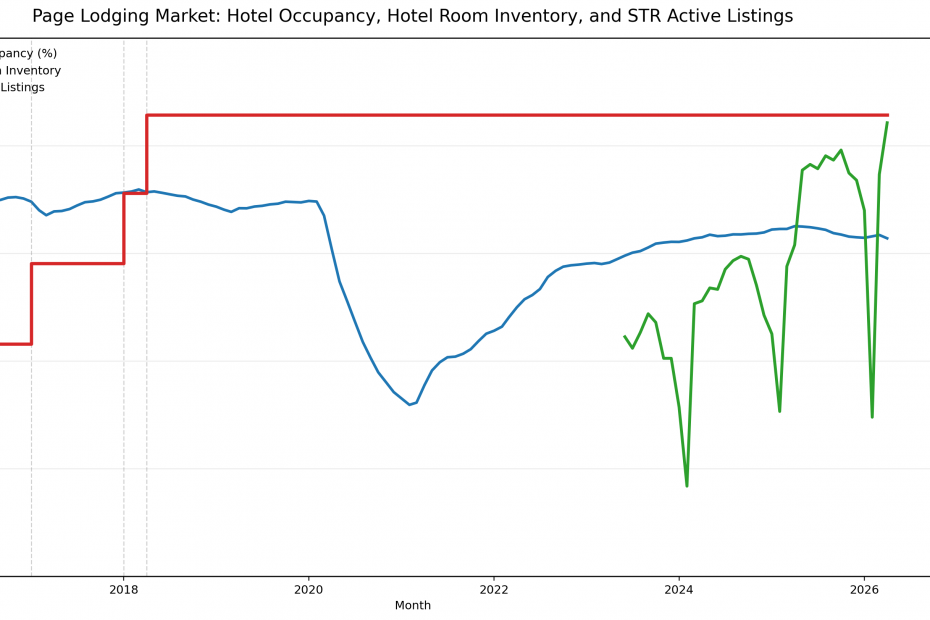
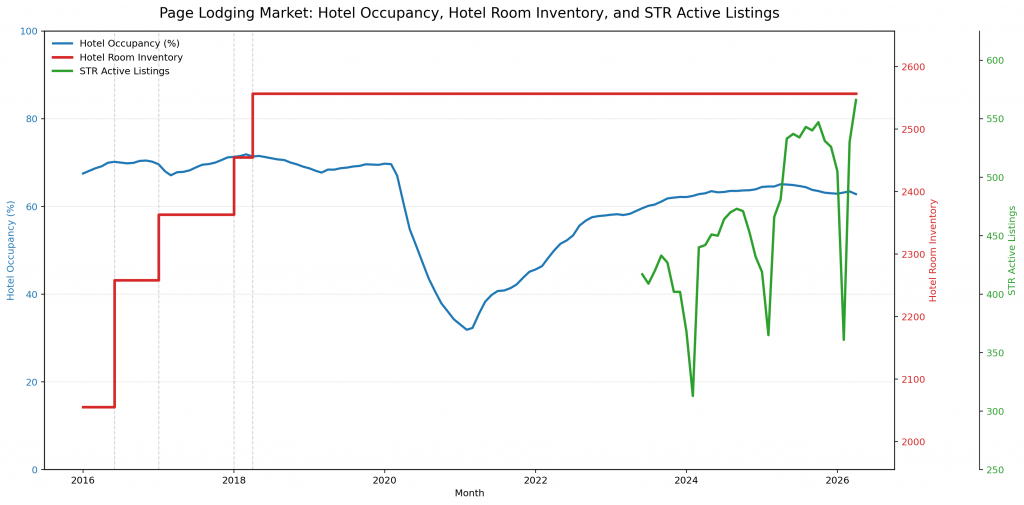
The chart below illustrates how Page’s lodging market has evolved over the past decade.
The blue line shows hotel occupancy, the red line shows hotel room inventory, and the green line shows the growth of short-term rental (STR) listings.
At first glance, some may notice that hotel occupancy has not fully returned to the approximately 68–70% levels seen prior to the pandemic. Today, occupancy remains strong at roughly 63–64%, a decline of about 6–7 percentage points.
However, the chart also shows that the number of lodging options available to visitors has increased significantly. In addition to new hotel development, Page has added roughly 550 short-term rental units in recent years, dramatically expanding the community’s overall lodging inventory.
Unlike hotels, which are typically developed only after extensive market research, demand forecasting, and feasibility analysis demonstrate sufficient visitor demand, short-term rentals can enter the market much more rapidly and with fewer barriers. As a result, lodging inventory has grown faster than occupancy, placing downward pressure on occupancy percentages even as visitor demand remains strong.
This helps explain why occupancy rates alone do not tell the full story.
If tourism demand had declined significantly, we would expect to see corresponding declines in hotel tax revenues and sales tax collections. Instead, Page continues to generate record levels of tax revenue, indicating a strong tourism economy despite lower occupancy percentages.
The data suggests that Page is not experiencing a decline in visitation, but rather a change in how visitors choose to stay. As the lodging marketplace evolves, occupancy rates should be viewed alongside broader economic indicators that continue to demonstrate the strength and resilience of Page’s tourism industry.
It is also worth noting that hotel occupancy continues to exceed short-term rental occupancy rates, which sit at around 55% today. Despite the rapid growth of alternative lodging options, hotels continue to capture the majority of overnight demand (80%), and remain a critical component of Page’s tourism economy.